Table of Contents
- What's your history with Eastern Accents?
- That’s really amazing.
- High Point must be so intimidating for new designers — do you have any advice for beginners?
- Is there anything else you wish you’d known when you were starting out?
- I’m curious about your path to founding Jessica Duce Design.
- Do you feel like you grew up in the industry?
- How would you describe your personal aesthetic?
- You’re based in Houston now — is that where you’re from originally?
- How does the Vacation Rental Designers Collective come into all of this?
- So what makes a brand a good fit?
- How does a residential project differ from a vacation rental?
- When you design a vacation rental, are clients looking for a neutral, blank-slate aesthetic?
- Do property owners usually come to you with a idea of the look they want?
- What do your projects typically look like?
- That's the interesting thing about designers: you’re a creative, and you are also a businesswoman.
- How does that work — juggling the creative side and the business side — do you find your banking background helped you with that?
- I think that’s how it is for all good businesspeople, though.
- You must have travelled everywhere working on vacation rentals— what have been some of your highlights?
- Do you have any dream projects?
- How would you like to do it?
- Well I'll let you go — I hear Louise is keeping you busy.
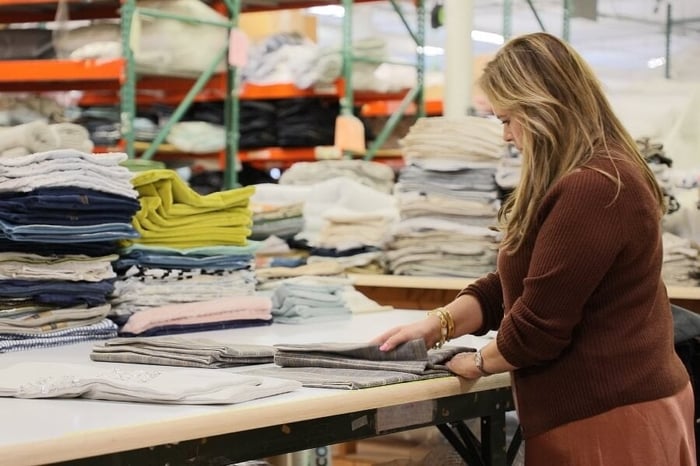
Jessica Duce is a Houston-based interior designer and owner of JDuce Design. Specializing in vacation rental design, she recently launched the successful Vacation Rental Designers Collective as a resource for other designers. We were honored to host Jessica on a tour of our Chicago factory earlier this month, culminating in an enlightening talk for the local vacation rental design community. She even got hands-on in the factory and shadowed our production departments for a day. While Jessica was here, we got a chance to sit down for an exclusive chat about design, travel, and the power of ‘scrappy’ ingenuity.
♦
What's your history with Eastern Accents?
When I first went out on my own as a designer I lived in Omaha, Nebraska. I learned about Eastern Accents and I remember literally thinking, wow, maybe someday I’ll get to buy something from them. I didn’t even apply for an account. I was too little. The price point was not something that I was ready for with the people I was working with. So I literally had a vision board and an Eastern Accents bedroom was on my vision board of a company I would work with, and then here we are.
That’s really amazing.
Now it’s 20 years later! I’ve always known about you guys and I finally opened my account after one of my moves. What really changed it for me was going to High Point. When I walked through the showroom, [EA creative director] Louise was one of the first people I was introduced to. She was just being polite and showing me around, and I noticed some art and she said she had made it herself.
It was such a welcoming atmosphere. I actually assumed I wouldn’t be welcome in the showroom because I was a new designer, new to High Point. It’s very intimidating to go there. But Eastern Accents was very friendly when I went into the showroom, and I’ve been a fan ever since.
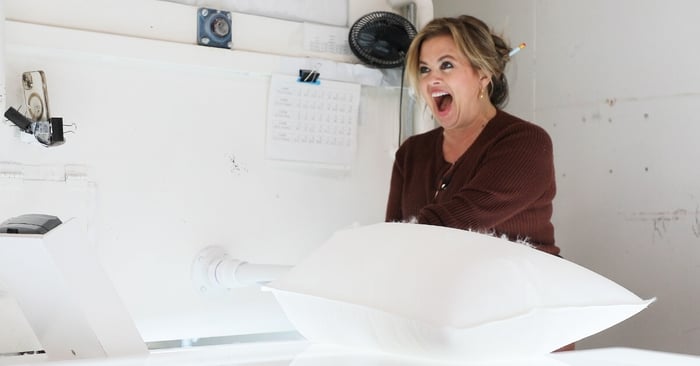
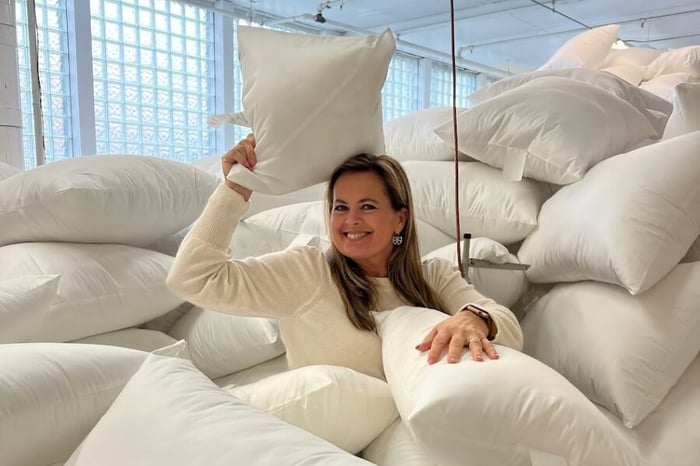 Jessica shadowed each department in our Chicago factory... and got swept up in the pillow forms
High Point must be so intimidating for new designers — do you have any advice for beginners?
If you’re a first-timer at High Point, you’ve gotta do an insider tour. That is the way to do it, because High Point is overwhelming, and you’re not gonna have the best experience if you try to navigate it for the first time by yourself. That’s the number one rule.
The way I look at High Point—I leave inspired. But I have to break it up in chunks. So I take High Point and I make it into a pie and I do a piece of pie each day, because there’s so much. I’ve been to all the markets and High Point is on a totally different level. I love it. I come back energized and excited.
Is there anything else you wish you’d known when you were starting out?
I wish I’d learned to spend more money on photography and styling early on. The old adage that you have to spend money to make money is true.
And I wish I’d been more confident, faster at putting myself out there. The biggest advancements in my career have been when I risked it and taken a chance. There are more wins than losses when you take chances.
I’m curious about your path to founding Jessica Duce Design.
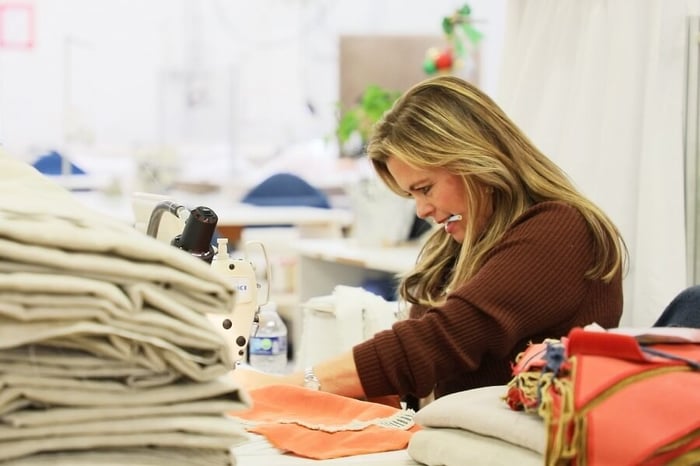
Well, my mother was a designer. So I was never gonna be a designer like her! I always said I would never do that. I actually went to college for archaeology — and that didn’t last long. I ended up going into banking and business banking; it was an easy job for a mom to have. I ended up helping the branch manager fluff her office and then another branch manager asked me to help with their office… and then the next thing I know I’m at their house and a year and a half later, I was redoing lobbies for Wells Fargo.
And my mom said, you have a design business inside a bank, do you realize that? And so I quit the bank and started my own design company.
Do you feel like you grew up in the industry?
My first design appointment was when I was 12 years old. My mom asked me to carry the fabric books, that was my only job. While they were talking about the design of the space, I gave my input and I was fired and told to go sit in the car. So my first design appointment ever, I was actually fired from.
How would you describe your personal aesthetic?
My personal aesthetic is eclectic, because I like everything. So my house is a hodgepodge of anything I like. But as far as my mark on projects, this is just my personal thought, but you should never be able to tell that that’s a Jessica Duce project or a JDuce design project, because it shouldn’t be my personal look. It should be what the project needs.
You’re based in Houston now — is that where you’re from originally?
I grew up in California and then in Omaha, Nebraska. I’ve actually had to move my business three times for my husband’s work. This last move to Houston, I told my husband that if he got another opportunity, I would miss him, because I don’t want to move anymore. But we love Texas.
I had never been to Texas until I moved there. It’s very friendly, very collaborative and supportive. I like the designer community there. Design culture is thriving; interior design seems to be important to people. But what I really love is that the designers were so welcoming. You know: here are the resources you will need. I’ve lived in other places where I didn’t experience that.
How does the Vacation Rental Designers Collective come into all of this?
When I first started working on vacation rentals, I couldn’t find other communities doing what I was doing. We source differently, we design differently. I had support when I worked in residential design, and in commercial design you can find organizations and all that. But I couldn’t find anybody doing what I was doing. So I pitched the idea to have a vacation design summit at High Point in HPXD. We had our first summit, and thankfully it was a success.
We sold out, had a long waitlist; 250 people came. That’s when I realized that there were other people out there that wanted a community like I did. So I threw together the collective within days of the first summit, hoping that other people would want to do this.
We’re about a year and a half old and we have almost 80 members and 30 brands and we are growing. It was designed to be a community that could be supported by education, collaboration, and just a way to bond. I also knew that, to be supportive for designers, I needed to have brands that were vetted and were a good fit for this kind of work.
So what makes a brand a good fit?
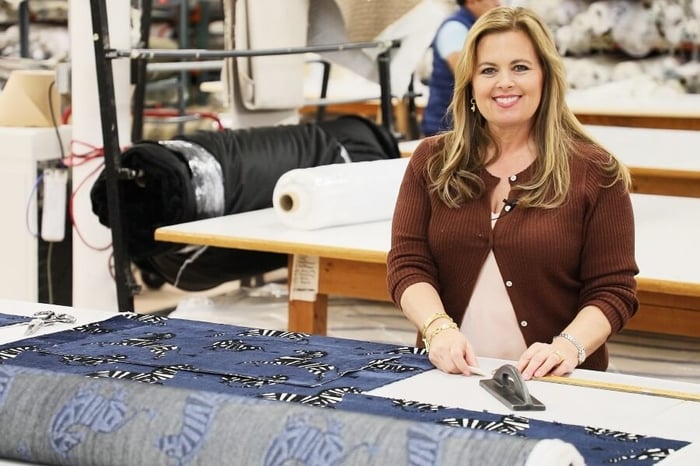
Drop shipping, quality, stock that we know will always be available. So if I do a 10-bedroom home and I pick a very specific kind of bedding, if that bedding isn’t available in a year or two when I need more, that’s a problem.
I have found, by building the vacation rental designer collective, that what we’ve created has actually become beneficial for residential designers too. So our designers are a true mix of both.
How does a residential project differ from a vacation rental?
To be honest, our vacation designer clients feed our residential business and vice versa, because they all have a home, and some residential clients have vacation homes.
When you design a vacation rental, are clients looking for a neutral, blank-slate aesthetic?
It used to be like that, and it’s not anymore. But that was the original idea. The first vacation rental I did was in 2015, and here we are in 2025 and our entire premise of how to do vacation rental design is completely different. People don’t want to rent a property or home that looks like their house or their neighbor’s house. It has to be sophisticated and elevated, but also different. And not kitschy.
My first instinct in 2015, when I did a beach house was: I’ve got to find seashells, you know, and beach things. We don’t do that anymore. We are going for quality, we’re going for longevity, and we’re going for a look that you’re not going to expect in your neighbor’s house.
Do property owners usually come to you with a idea of the look they want?
They’re sayings things like: what would you do? We get to have a lot of flexibility. The biggest challenge is educating owners and property managers on how to get the most bang for your buck with your budget, and where to spend the money.
What do your projects typically look like?
All of our projects are what we call soup to nuts. From the very first photo a guest will see online to the branding, the logo, the messaging, the email conversation, the website, and down to the last teaspoon in the house. The last email that says thanks for coming, we hope you come back. We do all of that: branding logo, everything. We touch every part.
We have some outside sources we bring in for all our projects. Our very first step before any owner or property manager works with us is we do a data project and we research all the reviews, positive and negative, income, rental, ROI, what your guest’s avatar is… before we do anything for branding, logo, and design.
That's the interesting thing about designers: you’re a creative, and you are also a businesswoman.
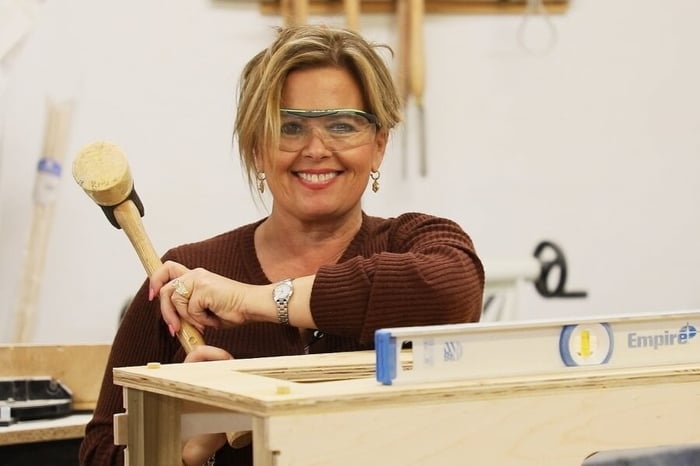
I think that’s the biggest difference between vacation rental design and residential design. I look at every project as a business and residential is just: I want the client to be happy with her house.
How does that work — juggling the creative side and the business side — do you find your banking background helped you with that?
I would love to think that, but I think I’ve sometimes had to learn things the hard way. I’m scrappy and if I can’t figure it out, I research it. I’d like to tell you that I’m this brilliant business brain, but I think I’m just scrappy.
I think that’s how it is for all good businesspeople, though.
When I was walking through Eastern Accents’ factory people were pointing out that [EA co-founder] Ridvan invented this, or he put that machine together. I don’t want to call him scrappy, but I get that. It’s just like: I need this and I’m gonna figure out how to do it. I love that, the ingenuity. And let’s just get it done. You have to be willing to try things, and be willing to fail. I’ve failed many times, but I keep trying.
You must have travelled everywhere working on vacation rentals— what have been some of your highlights?
They’re all really unique. Right now I’m working in Carmel, California which is a magical, beautiful place. And we’re working in Gatlinburg; we’re working in Brenham, Texas; and in Bandon, Oregon. But we’re also working in Green Bay, Wisconsin.
This home in Green Bay: they bought a house that’s very close to the stadium and turned it into a short-term rental. So any time of the year when there’s not a football game, it’s like $150 a night. But on game day it’s $4000 for two nights. We did the house and it has cheese wallpaper and everything in the home is green and yellow. Everything.
When people hear that I’m a vacation designer, they think exotic but the Wisconsin project was really fun; I loved working there. The ROI at that little Green Bay house is higher than the 10k square foot house I did in Walport, Oregon, on the beach. So you just never know.
Do you have any dream projects?
Right now we are in talks to do a motel, and I really want to do that.
How would you like to do it?
I don't know yet, but I just think it would be a unique opportunity. The people we are talking to, it would be a new construction. And so… do you make every room different? Do you make them flow?
There’s a romanticism to the motel. But what’s different about the modern motel is that the shared living spaces outside of your motel room are really important, so maybe that’s where you really focus on your creativity. I don’t know, but I want to do it.
And then I just finished a big project in Bandon, Oregon and it’s been doing well. They’re very happy so we’re talking about doing another one. It’s in the same area — also in Bandon, Oregon, because that is this beautiful golf area. It’s one of the top-rated golf courses in North America, and it looks like Scotland. And it’s all along the coast of Oregon. It’s like the forest meeting the ocean, I think that is their slogan. It’s just very beautiful. I love it there. I feel like I breathe cleaner air and it is just gorgeous.
Well I'll let you go — I hear Louise is keeping you busy.
And I’m going to be doing about every job there is in the factory! I’m very excited — it’s amazing what [EA founders] Siw and Ridvan have built. I was just in a meeting with a gal who owns 250 rentals in Gatlinburg and I’m like: these are the people you want to work with. They’ve hired us to tell their story because they’re the founders of Gatlinburg, and so their heritage is important to them. So I said, you gotta work with Eastern Accents. It’s heritage, it’s legacy, it’s family.
To learn more from Jessica Duce, check her out on Instagram or catch a spot on her popular Jessica Duce + Elizabeth Scruggs tour of High Point Market.