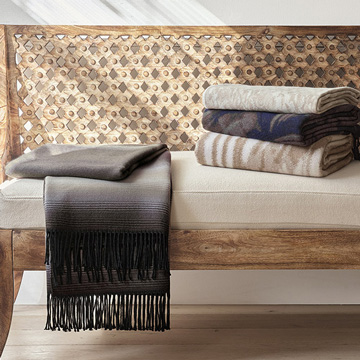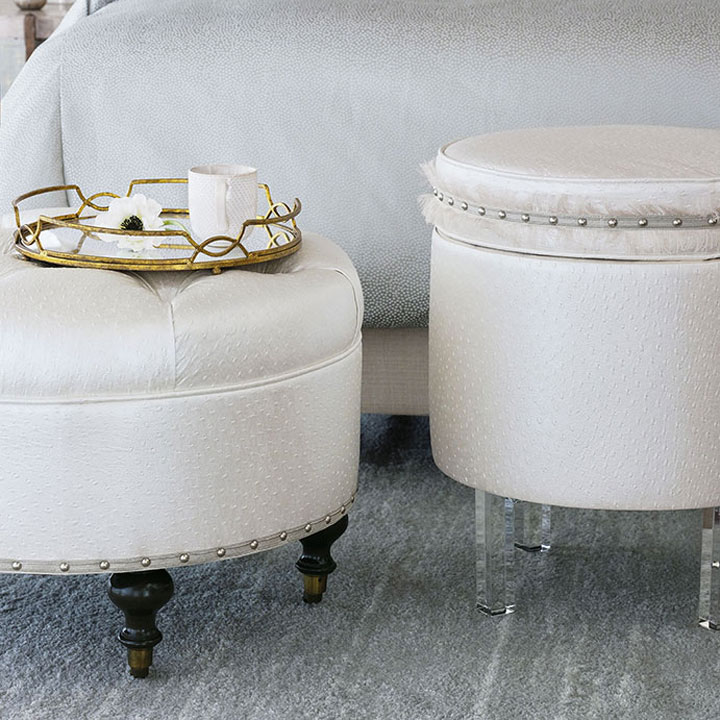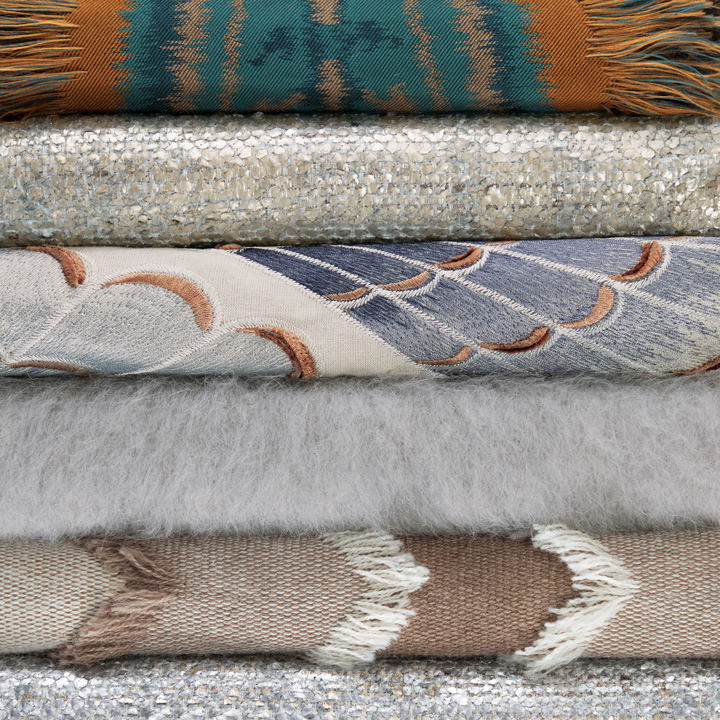
Your Eastern Accents bedding and soft home accessories will last for years if they are well cared
for. We strongly recommend that all finished products be professionally
cleaned.
Cotton Blend Duvets and Coverlets
We recommend professional cleaning and we
do not recommend that you wash these at home. If you decide to wash them
yourself, here are some general guidelines:
Wash them using sheeting instructions, but
they must be air dried and blocked. Blocking means stretching it back into
shape. You will need a large surface area - some people use a bed. You will
still have some shrinkage, and taking this on is a big task. A wet coverlet is
heavy and difficult to handle.
Wool Blend Duvets and Coverlets
We strongly recommend that wool blends and ornamented products be cleaned professionally. Some basic information on wool:
Merino is wool of the smallest micron produced by sheep (only angora and
cashmere are of smaller micron sizes) classifying them as "soft"
wools. Soft wools have softly twisted yarns and surface nap. Because of the
surface nap - fibers that stand above the surface of the woven/knit fabric -
pilling can occur. This occurs from conditions of use but can also be
exacerbated by they mechanical action of any care process. The pills can be
removed with the use of several different devices on the market ranging from
sweater stones to professional depillars. This is something to be discussed
with your dry cleaning service.
Polyester Blend Duvets and Coverlets
We recommend professional cleaning and we
do not recommend that you wash these at home. Some basic information on polyester: Polyester "pills," and
will shed its pilling on natural fibers, diminishing the smoothness and
softness of the fabric. This occurs
from conditions of use but can also be exacerbated by they mechanical action of
any care process. The pills can be removed with the use of several different
devices on the market ranging from sweater stones to professional depillars.
This is something to be discussed with your dry cleaning service.
Silk Blend Duvets and Coverlets
We strongly recommend professional cleaning for silk blend duvets
and coverlets. Some basic information
on silk: it is one of the most delicate fabrics and must be treated carefully
to preserve its fine texture and softness. The weaving of the fabric may
contain minor irregularities, these are characteristic of fine silk yarn,
giving the fabric its beauty, luster and texture, and should be not be treated
as defects. Silk should not be allowed to get too soiled before cleaning.
Table Runners
For general cleaning, we recommend
professional dry cleaning. For spot cleaning stains, please refer to the Stain
Removal section at the end of this care document.
Savoy Linens
Machine wash in warm (not hot) water on
gentle cycle. You may use any mild detergent or soap. Use enzyme reactive stain
removers only. Do not use chlorine bleach, stain removers or detergents with
lighteners. Never pour detergent or soap directly on your textiles. Either pour
it in when the tub is full or dilute it. Do not use fabric softeners. These
only coat the fibers and make them "appear" to be soft. One cup of
white vinegar in the rinse water removes all traces of soap and leaves fabrics
smelling fresh.
The ideal way to dry linens is air only. A
line or rod is perfect, but you can use a railing or shower rod as well. If you
must use a dryer, use the lowest setting and never dry completely. During the
last few minutes of a dryer cycle the fabric overheats and dries out, making it
brittle and lifeless over time. Always remove them from the dryer while still
damp.
Cleaning and General Care of Leather
Some Eastern Accents products incorporate the use of leather. While it is not involved in many of our
collections, the following are some general guidelines for cleaning and care:
Do not allow leather to become too soiled before cleaning. To keep leather
supple and clean we suggest professional cleaning. For at-home care, gently clean with a wet soft cloth and a mild
non-detergent soap. Lightly rinse off and pat dry. If not allowed to dry
completely, mildew may occur.
Care of Down Comforters
If soiled or stained, down comforters and pillows can be spot cleaned with a damp
cloth and mild soap. For cleaning down duvets and pillows, we recommend
laundering rather than dry cleaning. Laundering rejuvenates the lofting quality
of down, making duvets and pillows full, fluffier, and fresh smelling. You may wash down items in a front-loading,
extra capacity washer (the kind used by professional laundries) using a mild
detergent in warm water. Do not use top loading washing machines or the
agitation may damage the delicate cotton cover. Some modest shrinkage or
wrinkling may result from washing, but will not be visible once the duvet is in
a duvet cover. Down duvets and pillows dry best in the sun. Spread them
out on a sheet on the grass or deck, and shake them vigorously from time to
time while drying. Or you may tumble dry in a dryer set on medium heat. Remove
every hour and fluff. Placing a few tennis balls in the dryer will facilitate
the drying. Be certain your down comforters and pillows are thoroughly dry
before returning to the bed or storage – this will prevent mildew. Always store
in cotton bags, never in plastic.
Care of Poly Comforters
If soiled or stained, poly comforters and pillows can be spot cleaned with a damp
cloth and mild soap. For cleaning poly duvets and pillows, we recommend
laundering rather than dry cleaning. You may wash poly items in a
front-loading, extra capacity washer (the kind used by professional laundries)
using a mild detergent in cold water. Tumble dry in a dryer set on low heat. Remove every hour and fluff.
Placing a few tennis balls in the dryer will facilitate the drying. Do not over dry and remove promptly from
dryer to prevent excessive wrinkling.
Stain Removal
BERRIES AND FRUIT: If the stain is still
wet, sprinkle with salt and gentle liquid soap. Let sit for a couple of hours,
and rinse well. If the stain is dry, a solution of borax (one part borax to six
parts water) may remove the stain. Soak until it has disappeared.
BLOOD: Attend to bloodstains immediately.
Rinse well in cold water (never hot—it will permanently set the stain), then
try one of the following: a) sprinkle the stain with unflavored meat
tenderizer; or b) blot on hydrogen peroxide with a damp cloth, allow to bubble,
then wipe with a fresh cloth. Repeat if necessary. For dried bloodstain: soak
overnight in cold water and two cups of salt. Wash as usual.
BUTTER OR MARGARINE: Mix one teaspoon of
detergent with warm water. Apply to spot and blot. You may need to repeat a few
times. Or mix one part white vinegar and two parts water. Saturate the stain
and blot until dry. Wash as usual.
CANDLE WAX ON TABLE LINENS: Gently peel
away the wax that can easily be removed with your fingernail. If the wax is
soft, harden with an ice cube. Place the item between two sheets of brown
paper, and press with a warm iron; the remaining wax will be absorbed by the
paper. If the wax is colored, wash with a bleaching agent.
COFFEE OR TEA: Apply a borax solution (1
part borax to six parts water) directly to the stain, then wash in warm, soapy
water.
GREASE: Do not allow grease stains to set!
Sprinkle fresh grease stains with baking soda or cornstarch and leave for a
couple of hours until the powder gets thick. Scrape away and repeat the process.
Brush off the powder and launder as usual.
GRASS: Mix one-third cup vinegar and
two-thirds cup water. Apply to stain and blot. Or pre-soak in hydrogen peroxide
and launder as usual.
LIPSTICK: Scrape off as much as you can
with a dull knife. Use a pre-wash spray and rub with a clean white towel. Wash
as usual.
MILDEW: Apply white vinegar and lemon juice
to kill the mildew. Let the item sit in the sun for a few hours. Wash as usual,
but separately.
SCORCH MARKS: Treat the same way as mildew,
but drying in the sun is not necessary.
WINE: White wine is easily removed with
normal laundering. Red wine stains can be handled two ways: a) rub salt on the
stain, and soak in cold water; if the stain is stubborn, rub the salt into it
to remove; or b) saturate the stain with club soda until it disappears.
Cleaning methods and terminology
Dry Cleaningis by definition, cleaning with solvents and little
or no water.
Spot Clean for solvents must be distilled to remove greases, oils,
waxes and dyes. Poor solvent purity or quality can result in an objectionable
odor in the garment and a "graying" of white clothing. Clean only
with dry cleaning solvent. Do not saturate. Do not use water. Pile fabric may
require brushing to restore appearance.
Pressing after cleaning should also be considered. Linen can withstand higher heat
when ironed, and should be pressed when damp. Silk requires a lower temperature
iron and should be steam ironed, preferably with a press cloth. Wool should be
pressed with steam and a moderate temperature.
Wet Cleaning is described as a new process by some cleaning establishments. They
advertise that their process will replace dry cleaning and the environmentally
dangerous solvents they use. Wet cleaning is accomplished by using water-based
chemicals. Clean only with water based shampoo or foam upholstery cleaner. Do
not over wet. Do not use solvents to spot clean. File fabrics may require
brushing to restore appearance.
Water Solvent should be
cleaned with shampoo, foam or dry cleaning solvents as desired. Do not saturate
with liquid. Pile fabrics may require brushing to restore appearance.