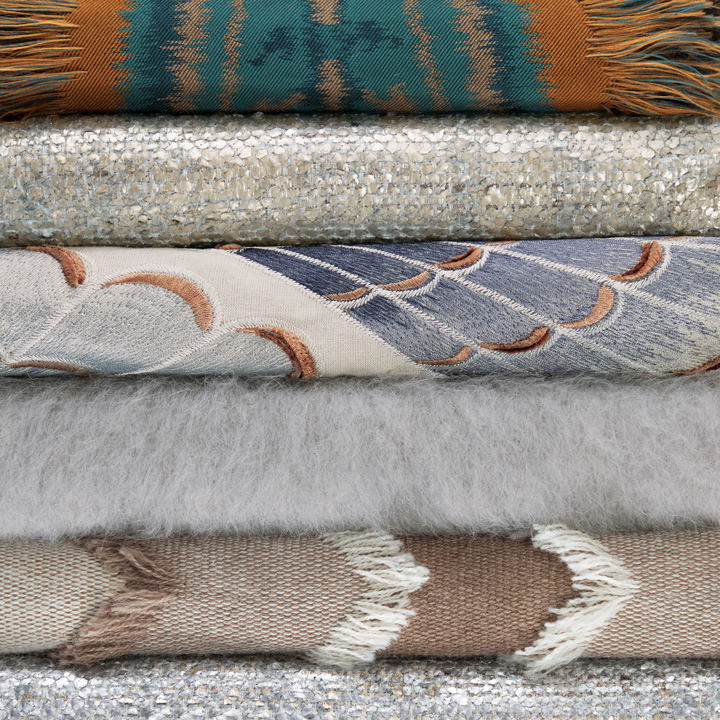
Acetate: Acetate is a man-made fiber composed of acetylated cellulose.
Acrylic: Acrylic is a man-made fiber derived from petrochemical by-products.
Bolt: A bolt is an entire length of fabric rolled full-width on a tube.
Border: A border is similar to a gimp, but is wider than a gimp. It is a flat, woven textile made in many styles. One or both edges of the border can be plain, cut, or have scalloped loops. Borders are also sometimes woven in plain patterns such as stripes or chevrons.
Bouclé: Bouclé is a novelty yarn which is looped and crimped to produce a pebbly surface.
Brocatelle: Brocatelle was originally meant to be an imitation of Italian tooled leather created on a plain or satin background, with a satin or twill pattern. Brocatelle is characterized by a smooth, raised figure of warp-effect, often in a satin weave, atop a filling effect backdrop. Actual brocatelle is a double weave constructed of silk and linen warp with a linen and silk filling. Modern-day materials have changed from the 13th and 14th century fabrics, but still incorporate the embossed figure in a tight, compact woven warp-effect. Although brocatelle is sometimes considered a flat fabric, it displays patterns that stand out in a sort of high relief, blistered effect.
Brush Fringe: A brush fringe is a cut fringe that has a flat skirt made of thin yarns. The heading of a brush fringe can vary from plain to elaborate.
Bullion Fringe: A bullion fringe is a fringe made of plain or crepe cords rather than yarns. The heading can range from plain or decorative.
C.O.M.: C.O.M. stands for Customer's Own Material.
Calendaring: Calendaring refers to a process for finishing fabrics that can produce high luster, embossing, glazing, or moiré.
Cartridge Pleat Curtain: A cartridge pleat panel has approximately 1 ½” diameter pleats with cardboard tubes inserted in the pleats to stabilize and maintain the shape of the pleats.
Cashmere: Cashmere is a fine fiber obtained from the undercoat of the Himalayan Cashmere goat.
Chenille: Chenille is a special yarn with pile protruding on all sides that is produced by first weaving a fabric—usually with cotton or linen warp and silk, wool, rayon, or cotton weft. The warps are taped in groups of four and the wefts are beaten in very closely. After weaving, the fabric is cut lengthwise between each of these groups of warp yarns, each cutting producing continuous chenille which is then twisted. The word “chenille” means “caterpillar” in French.
Chiffon: Chiffon is a plain woven, soft, sheer fabric often made of silk or rayon yarns.
Chintz: Chintz is a cotton fabric, with or without a printed pattern, that has a glaze created by applying resin and calendaring.
Collage: Collage is a term used to describe the style of a product in which more than two different fabrics are being used.
Cord: A cord is plied yarn (plies) that has been twisted together. When used for a seam, a tape is sewn onto the edge of the cord. Cords are frequently used in place of fabric welts.
Corduroy: Corduroy is cut pile fabric, usually made of cotton, in which the ribbed pile is produced with a supplementary weft yarn.
Cotton: Cotton is a natural, cellulosic seed hair fiber obtained from the seedpod of the cotton plant.
Crewel: Crewel is a hand embroidery technique from Kashmir in which fine, loosely twisted two-ply yarn is chain-stitched on cotton cloth. Imperfections, color variations, irregularities, natural black specks, dye marks, and dirt spots are characteristics that label it as genuine. These fabrics are handwoven by natives in India, and the beauty of the cloth is in its natural, homespun appearance.
Crushed Fabrics: Crushed fabrics are those treated with heat, moisture, and pressure in finishing to distort pile formation.
Cut Length: Cut length is the length of fabric after allowances have been made for headings and hems.
Cut Pile: Cut pile is a fabric in which the pile is cut rather than looped, creating a velvet effect.
Cut Width: Cut width is the width of fabric after allowances have been made for headings and hems.
Cut Yardage: Cut yardage is a fabric or trimming ordered to a specific measurement, as opposed to purchasing by the piece or bolt.
Damask: Damask was originally a rich silk fabric with woven floral designs made in China and introduced to Europe through Damascus, from which it derived its name. Typically, damasks are woven with a single beam (warp) with one or two weft colors. Fancy damasks reveal a smooth warp satin in the background with a low lustre reverse satin in the motif. In two color damasks, the colors reverse on both sides. Single damask is made with a five-harness satin weave; the true, or double (or reverse) damask, is woven with an eight-harness satin weave and has a firm hand.
Decorative Rods: Decorative rods are curtain rods used for the purpose of decorating and are meant to be seen.
Denim: Denim is a yarn-dyed cotton cloth woven in a warp-faced twill, usually with a dyed warp and a natural weft.
Density: Density is a standard measurement of thickness in fabric weight. Yarn size, number of warp ends, and weft picks determine the density.
Double Valance: A double valance has two layers of fabric that are not sewn together on the bottom edge. The top layer of fabric is typically shorter than the back layer of fabric.
Doupione: Doupione is an irregular slub silk reeled from double cocoons or silk worms which have spun their cocoons side by side causing an interlock, making it necessary to reel them together. Antique taffetas and sheers are woven with doupioni weft yarn, as are many damasks.
Drapability: Drapability refers to how well a fabric can flow or fall into folds in an attractive manner.
Duck: Duck is a broad term for a wide range of plain weave fabrics. Duck is usually made of cotton, although sometimes linen is used. The terms “canvas” and “duck” are often interchangeable, but canvas is often used to refer to heavier constructions. The term duck had its origins before the mid-19th century when all canvas for sails was imported. The light flax sail fabrics imported mostly from England and Scotland bore the trademark stencil of a raven, while the weights bore the trademark of a duck. The word duck became associated with a heavy fabric and was applied to cotton canvas when it was first manufactured in the U.S.
Embossing: Embossing is a calendaring process which produces a raised design or pattern in relief. The design is pressed into fabric or leather by passing it through hot, engraved rollers. Velvet or plush is embossed by shearing the pile to different levels or by pressing parts flat.
Felt: Felt is a fabric made from fibers not taken to yarn form but instead enmeshed by heat, moisture, and agitation. Felt can also be a fabric made by shrinking and agitating woven or knit cloth to obtain superior density, resilience, and strength.
Fiberglass: Fiberglass is a man-made mineral fiber extruded in continuous filaments.
Filament: Filament is a continuous strand of silk or man-made fiber.
Filling (Weft): Filling or weft is an element carried horizontally through the open shed of the vertical warp in a woven fabric.
Flame-Resistant Fabric: Flame-resistant fabric is fabric with a fiber content or topical finish that makes it difficult to ignite and slow to burn.
Flame-Retardant Fabric: Flame-retardant fabric is man-made fabric with a fiber content that is made or treated to resist burning, and that passes most fire code requirements.
Flange: A flange is a decorative finish on a fabric, and is sewn into a seam. To avoid having the flange droop, a pellon may be inserted to stabilize the flange.
Flannel: Flannel is a woolen fabric with a surface that is slightly napped in finish.
Flax: Bast fiber is extracted from the flax plant's stem by retting to produce linen. Linen fiber is often mistaken for flax, particularly in blends.
Floats: Floats are missed interlacings, where a warp yarn lies on top of a weft yarn, or vice versa. Floats tend to make a fabric look glossier and give it a smoother hand. A float can also be grouped to form a pattern on the face, as in brocade.
Fringe: Fringe is a decorative edging with hanging tassels or threads.
Gimp: A gimp is a flat, narrow, woven textile made in many styles. One or both edges of a gimp can be plain, cut, or have scalloped loops.
Gingham: Gingham is a yarn-dyed, combed, or carded cotton fabric woven into a series of simple patterns (such as checks, stripes, or plaids) in two or more colors.
Hand: Hand is a qualitative term used to describe the tactile properties of a fabric. Literally, the word refers to the feel of a fabric in the hand.
Harlequin: Harlequin is a large check pattern that is turned 45 degrees to form a diamond in two or more contrasting colors. This term is suggested by the loudly checked costume of a harlequin.
Heat Transfer Printing: Heat transfer printing is a method that transfers designs from rolls of paper to polyester or other thermoplastic fibers. Designs are preprinted with disperse dyes on paper, and under high temperature are transferred onto fabric when both are passed through a heat transfer printing machine. Disperse dyes are the only dyes that can sublimate and, therefore, are the only dyes that can be used. This printing process is an adaptation of the decalcomania method.
Hem: A hem is a finished edge of a sewn item.
Herringbone: Herringbone is a twill weave that reverses direction across a fabric to form a chevron design.
Honeycomb: Honeycomb is a piqué weave in a hexagonal shape that is often referred to as a waffle weave.
Houndstooth: Houndstooth is a pointed check effect produced by a two-up, two-down broken twill with four ends and four picks in a repeat.
Interlining: Interlining is a layer of fabric between the face fabric and the lining.
Inverted Pleat: An inverted pleat is a reversed box pleat that causes a fabric's fullness to turn inward.
Iridescent: Iridescent refers to a color effect created by weaving warp ends of one color and a weft of another color. A taffeta weave results in the best iridescent effects.
Jute: Jute is a bast fiber obtained from the round pod jute or the long pod jute of the family Tiliaceae. It is grown extensively in Pakistan and India, and is mainly found in the Bengal district of Pakistan.
Kick Pleat: A kick pleat (or inverted pleat) is a reversed box pleat that causes a fabric's fullness to turn inward. This type of pleat is commonly used on the corners of a bed skirt to hide the bed frame legs.
Knife Edge: A knife edge is a seam without a decorative finish.
Lace: Lace is an openwork fabric produced by a network of threads that are twisted together and sometimes knotted to form patterns. Lace is made by hand with needles or hooks, or by machinery.
Linen: Linen is a strong, lustrous yarn made from flax fiber.
Lining: Lining is a fabric backing of an item such as a curtain panel.
Long-Staple: Long-staple refers to fabrics that have relatively long fibers.
Loom State: Loom state refers to goods as they come off the loom before converting or finishing. These goods are also called gray or griege.
Loop Fringe: A loop fringe is similar to a brush fringe except that the yarns at the base of the skirt are looped, not cut. The bottom edge of a loop fringe can be straight or scalloped.
Loop and Brush Fringe: A loop and brush fringe is a combination of loop and cut brush fringe styles in the same trimming.
Macramé: Macramé is a type of needlework that employs a variety of knots to create an open weave netting.
Matelasse: Matelasse is a woven fabric similar to a brocatelle. It has two warps that, in weaving, achieve a puckered or quilted effect. In French, “matelasser” means “to quilt” or “to pad”.
Mercerizing: Mercerizing is a process by which yarn or cloth is treated with sodium hydroxide to give it luster, strength, and receptiveness to dyes.
Meter: A meter is a universally accepted and commonly used measurement based in hundreds and is equivalent to 39.37 inches.
Mitered: Mitered refers to a border or a flange that is matched in the corners with a diagonal seam.
Mohair: Mohair is long, white, lustrous hair obtained from the Angora goat. Mohair plush is a fabric with a cut pile of mohair yarns that are lustrous and extremely strong, and will hold a permanent embossing.
Moiré: Moiré is a finishing process that produces a wavy or rippled pattern on a fabric, and is unique from fabric to fabric. In French, “moiré” means “watered.”
Muslin: Muslin is a plain weave strong cotton cloth.
Natural Fibers: Natural fibers refers to fibers derived from natural substances such as cellulose, proteins, and minerals.
Nylon: Nylon is a generic term for synthetic polyamide fibers.
Olefin: Olefin is a man-made fiber composed of at least 85% (by weight) of ethylene, propylene, or other olefin units.
Organza: Organza is a thin, transparent silk, rayon, or nylon fabric made in a plain weave and given a stiff, wiry finish.
Overlay Curtain: An overlay curtain has a sheer face fabric on top of a second, heavier face fabric, allowing the second fabric to show through the sheer fabric.
Padded Edge: A padded edge is a fabric border that is rolled and stuffed to form a long, round shape.
Passementerie: Passementerie refers to the vast range of trimmings and decorative edges.
Pattern Repeat: A pattern repeat is the distance between any given point in a design to where that exact point is repeated again.
Pellon: Pellon is a non-woven fabric that is used as an interfacing to shape, support, or stabilize areas of a product.
Pigment: Pigment is an insoluble powdered coloring agent carried in a liquid binder and printed or padded onto the surface of a cloth.
Pile: Pile is raised loops, cut interlacings of double cloths or tufts (cut loops), and other erect yarns or fibers deliberately produced on cloth which form all or part of the surface of a fabric.
Pill: A pill is a fuzzy ball caused by the rolling up of abraded surface fibers. When tangled together, pills look like tiny balls and detract from the appearance of a fabric.
Piping: Piping refers to decorative cords used at edges of an item. Piping is usually fabric-covered and is attached to an item by inserting it through a seam.
Piqué: Piqué is a fabric with an embossed appearance created by weaving ribbed, waffle, or honeycomb patterns.
Pleat: A pleat is a fold sewn into place to create fullness in fabric.
Pleat To: Pleat To refers to the finished width of fabric after it has been pleated.
Ply: Ply refers to the number of yarns twisted together to make a composite yarn.
Polyester: Polyester is a generic term for a manufactured fiber in which the fiber-forming substance is a long-chain synthetic polymer composed of a complex ester.
Raffia: Raffia is a leaf stalk fiber obtained from the raffia palm in Raffia, Madagascar.
Railroaded: Railroaded refers to a fabric with a pattern that runs horizontally rather than up the roll.
Rayon: Rayon is a generic term for a man-made fiber derived from regenerated cellulose.
Repeat: Repeat is a term used to describe how often a pattern repeats on a fabric.
Resin: Resin is a synthetic substance used in corrective fabric finishes to add body, reduce creasing, control shrinkage, produce luster in glazing, repel water, or supply permanent press.
Rope: A rope is a cord at least one inch in diameter.
Ruching: Ruching refers to the process by which a fabric is gathered to achieve an elegant effect. Ruching is mostly used in welts or on the face of decorative pillows.
Ruffle: A ruffle is gathered fabric often used in bed skirts and in place of a plain flange on pillows. The fullness of a ruffle is determined by the quantity of fabric used.
Seam Allowance: Seam allowance is a slim extra allowance in the fabric between the line for stitching and the raw edge of the fabric.
Selvage: Selvage is the edge on either side of a woven or flat-knitted fabric, often of different threads or weave, finished to prevent unraveling.
Shantung: Shantung is a lightweight silk cloth woven in a plain weave with doupioni yarn.
Sheer: Sheer refers to very thin, transparent, or semi-opaque fabric.
Side Hem: A side hem is the turned part of a fabric that forms a finished edge on the side of a sewn item.
Silk: Silk is a natural protein fiber produced from the cocoon of wild or cultivated silkworms.
Skirt Drop: Skirt drop is the length of a bed skirt, measured from the bed's box spring to the floor.
Super King: Super King is a term used for the Eastern Accents extra large king bed cover. The Super King size is recommended to accommodate a king bed with a pillowtop mattress.
Super Queen: Super Queen is a term used for the Eastern Accents extra large queen bed cover. The Super Queen size is recommended to accommodate a queen bed with a pillowtop mattress.
Tartan: Tartan refers to multicolored plaids originally made for kilts worn by Scottish clans.
Tassel: A tassel is a hanging ornament consisting of a head and a skirt of cut yarn, looped yarn, or bullion fringe. Tassels come in all sizes, shapes, and forms.
Tassel Trim: A tassel trim is a plain or decorative gimp with attached tassels.
Ticking: Ticking is a general term for a strong, durable, closely woven fabric in plain, twill, or satin weave, used for covering box springs, mattresses, and pillows.
Toggle Bolt: A toggle bolt is a nut with wings which close for passage through a small hole and spring open after passing through the hole to keep the bolt from slipping back through.
Toile: Toile is a linen or cotton cloth that is usually made in one color with a printed design that resembles a pen and ink technique. Made famous in Jouy, France in the 18th century when a new technique of engraved plate printing was popularized, toile was known as toile de Jouy. Toiles are printed by various methods, but the most beautiful are still created by engraved plates or rollers. In French, “toile” means “cloth.”
Tussah: Tussah is a brownish silk yarn or fabric made from wild silk cocoons of a brown hue. The silkworms that spin these cocoons feed on leaves from various plants and trees such as oak, cherry, and wild mulberry.
Tweed: Tweed is a fabric with a homespun effect created by multi- or monochromatic-colored yarns woven on plain looms. Usually made of wool or worsted, tweed often has a rough texture.
Twill: Twill is a weave that creates a diagonal effect by having the warp float on top of a few weft yarns, or vice versa; generally, three threads up and one down. Antique twill is woven as a twill with a doupioni yarn, having slubs intermittently dispersed across the fabric.
Velour: Velour is a fabric with a pile or napped surface resembling velvet.
Velvet: Velvet is a soft fabric that is either handwoven or machine-made. The machine-made velvet is a double-faced fabric that weaves two fabrics, face to face, joined by the weft yarns. These yarns are then cut automatically which forms the pile on both faces.
Velveteen: Velveteen is a fabric with a single weft, similar to velvet but generally much softer and typically used for apparel.
Warp: Warp refers to yarns placed on a warp beam and entered into a loom.
Weft: Weft is the yarn that traverses the warp yarns horizontally during the weaving operation. A weft is often referred to as filling.
Welt: A welt is piping covered with fabric and sewn into the seam of a product. Eastern Accents offers three sizes of piping: small (0.25”), medium (0.5”), and large or jumbo (1.5”). The finished welt size depends on the fabric used.
Wool: Wool is a fabric made from the hair of animals such as sheep, llamas, goats, and camels. It is a resilient fabric that is resistant to wrinkling, renewed by moisture, and known for its warmth. Varieties of wool include Alpaca, Angora, Botany, Cashmere, Merino, and Shetland.
Worsted: Worsted can be one of two things: either a firmly twisted yard or thread spun from combed, long-staple wool (often used for weaving); or a wool cloth woven from these yarns, with a hard surface and no nap.
Yard: A yard is a 36-inch American measurement. The American yard is 1/100,000th of an inch longer than the English yard.
|